THE SHORT ANSWER
A business website’s cost depends on five things: how many pages you need, how custom the design is, who writes the words, which features you need and whether you’re moving an existing site. Whatever the budget, a good site makes it obvious what you do, loads fast on a phone and makes the next step easy.
What should every business website include?
Before you compare quotes, agree on what the site must do. Use this as a checklist when you brief a designer or review a proposal.
- A clear headline that says what you do, for whom, and the result
- A dedicated page for each main service
- An About page with real people and a real story
- Proof: reviews, results, case studies or client logos
- A clear call to action on every page
- Fast loading on mobile
- Technical SEO basics: titles, headings, structured data and a sitemap
- Analytics and conversion tracking
- A privacy policy, terms and a facts page
If a quote doesn’t cover most of this, ask why. Some items may be your job, such as supplying reviews. Others, like mobile speed, should never be optional.
What drives the price?
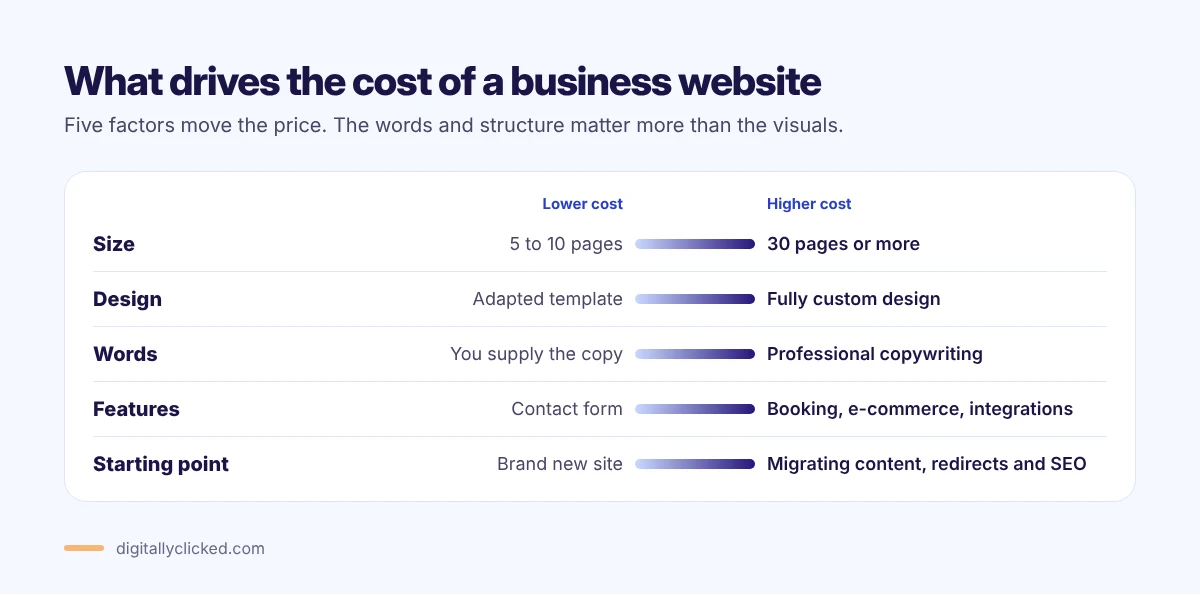
Two websites can look similar and cost very different amounts. These are the five factors that move the price most.
| Factor | Lower cost | Higher cost |
|---|---|---|
| Size | 5 to 10 pages | 30 pages or more |
| Design | Adapted template | Fully custom design |
| Words | You supply the copy | Professional copywriting |
| Features | Contact form | Booking, e-commerce, integrations |
| Starting point | Brand new site | Migrating content, redirects and SEO |
Size matters because every page needs planning, writing, design and testing. Design matters because a custom layout takes longer than adapting a well-made template. Words are often underestimated: clear copy is the biggest single factor in whether a site brings in enquiries. Features like booking or online payments add build and testing time. Starting point matters because moving an existing site means mapping old pages to new ones so you don’t lose search rankings.
Template or custom design?
A well-chosen template, properly adapted, can be a smart choice when you need to move quickly or your budget is tight. A custom design makes sense when you need to stand out in a crowded market, have an established brand to express, or need layouts a template can’t handle.
Either way, the words and the structure matter more than the visuals. A beautiful site that confuses visitors still won’t bring in enquiries.
What are the ongoing costs?
The build is only part of the cost. Plan for:
- Hosting and domain renewal, usually billed yearly.
- Security updates and backups, so the site stays safe and recoverable.
- Small content changes and new pages as your business changes.
- Ongoing SEO and content if you want the site to keep growing its traffic and its presence in AI answers.
Ask every supplier what’s included after launch and what costs extra.
What are the red flags in a website quote?
- No mention of SEO, redirects or page speed.
- You won’t own the website, its files or the domain.
- Hosting you can’t move without paying a penalty.
- No testing on mobile devices.
- A price with no list of what’s included.
Always make sure your domain, hosting account and website files are in your name.
A worked example
This is an illustrative example, not a client result.
A landscaping company gets two quotes. Quote A is for a 6-page site on an adapted template, with the owner writing the words. Quote B is for a 12-page custom site with professional copywriting, a project gallery and redirects from the old site.
Quote B costs noticeably more. Looking closer, the owner realizes the old site has three pages that bring in most enquiries from Google. Quote A doesn’t mention redirects, so those rankings could be lost on launch day. The owner chooses a middle path: the template build from Quote A, plus copywriting for the three main service pages and a redirect plan. The budget stays reasonable and the pages that already earn money are protected.
How do you get an accurate quote?
Send every supplier the same brief. Include your main goal, the pages you think you need, who will write the words, the features you need, your current site’s address, and your deadline. The more specific the brief, the easier it is to compare quotes fairly.
We quote every website as a fixed-price project before work starts. See our website design service, or book a free chat to talk through your brief. If you want to know how your current site shows up in AI answers first, try our free AI check.
How should you plan the pages?
The page list drives both cost and results, so plan it before you ask for quotes. Start with the questions buyers ask before they contact you, then give each important question a home.
- Home: what you do, for whom, and the one next step you want visitors to take.
- One page per service: what it is, who it’s for, how it works, what it costs or how it’s priced, and common questions.
- About: the people behind the business and why they can be trusted.
- Proof: reviews, results or case studies, on their own page and next to the services they relate to.
- Contact or booking: one clear way to get in touch, plus your details.
- Facts and policies: a short facts page, a privacy policy and terms.
A small business can often start with 6 to 10 pages and add guides or case studies later.
How should a website work with AI search?
More buyers now ask AI tools for recommendations, and those tools read websites to form their answers. A few choices during the build make your site far easier for them to use:
- Open each service page with a one- or two-sentence answer to “What is this, and who is it for?”
- Keep your business name, address and services identical on every page and profile.
- Add structured data (schema) so your business, services and FAQs are labeled clearly.
- Don’t hide important text inside images or behind buttons that need clicks to reveal it.
- Publish a facts page with your key details in one place.
None of this changes how the site looks to visitors. It changes how well machines understand it.
Who should own what?
Ownership is easy to get right at the start and painful to fix later. Before the build begins, agree in writing that:
- The domain is registered in your business name, with your email as the contact.
- The hosting account is yours, or can be moved to you at any time without a fee.
- The website files, design and content belong to you once the project is paid for.
- Your analytics, Search Console and Google Business Profile are set up under your accounts, with your designer added as a user.
If a supplier is unwilling to agree to this, treat it as a warning sign, whatever the price.
Key takeaways
Common questions
It depends on size and content. A focused site often takes several weeks; larger custom builds take a few months. Waiting on content is the most common cause of delay.
WordPress is a flexible, widely supported choice for most business sites. The right platform depends on your needs and who will update the site.
Not always. Many sites can be improved without a rebuild. A rebuild makes sense when the structure or technology is holding you back.
Yes, and you know your business best. Ask your designer for a page-by-page outline first, so your words fit the layout and answer the questions buyers ask.
Every website is a fixed-price project, quoted before we start. Our pricing page explains what’s included.