THE SHORT ANSWER
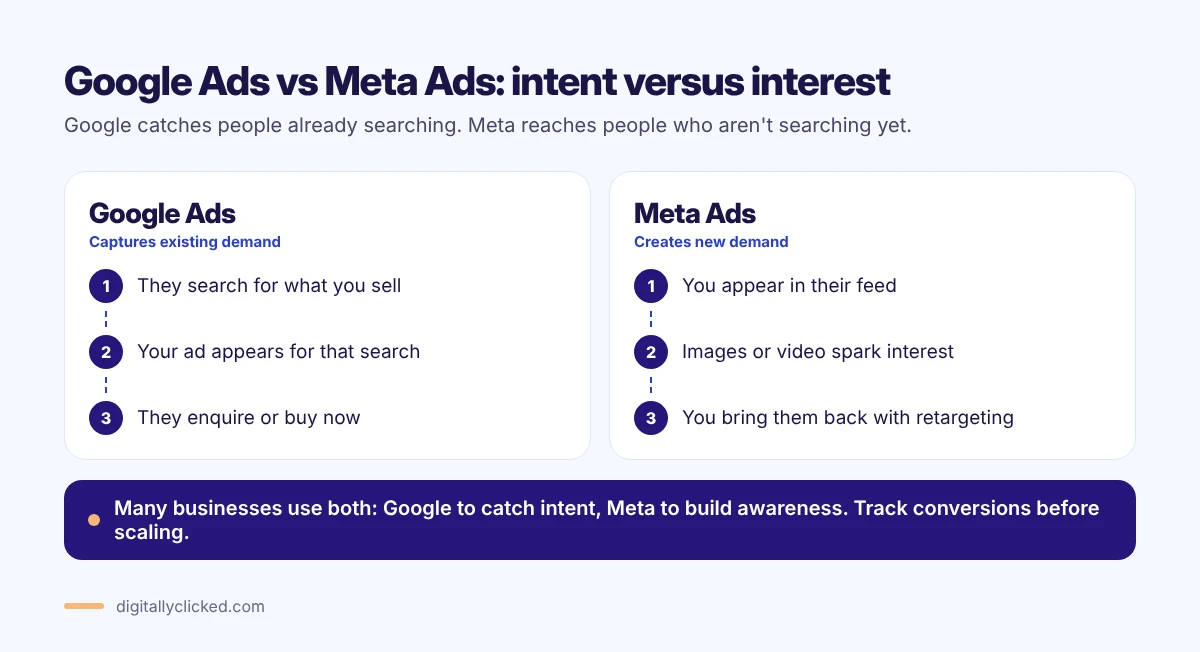
Google Ads reaches people who are already searching for what you sell, so it’s usually best for capturing existing demand. Meta Ads (Facebook and Instagram) reaches people based on who they are and what they like, so it’s best for creating demand, especially for visual products. Many businesses use both.
What’s the real difference between Google Ads and Meta Ads?
The simplest way to think about it is intent versus interest.
On Google, the person tells you what they want by typing a search. “Emergency plumber near me” is a person with a problem right now. Your ad appears because of what they searched for.
On Meta, the person isn’t looking for you. They’re scrolling. Your ad appears because of who they are: their interests, location, age or similarity to your existing customers. You have to catch their attention and create the want.
| Google Ads | Meta Ads | |
|---|---|---|
| How people find you | They search for it | You appear in their feed |
| Best for | Services people actively look for | Visual products, offers, awareness |
| Creative | Text ads and keywords, plus visual formats | Images and short video |
| Targeting | Search terms and intent | Interests, demographics, lookalike audiences |
| Typical goal | Enquiries and sales now | Reach, demand and retargeting |
Which should you start with?
Answer these four questions in order.
- Do people already search for what you sell? If yes, start with Google. You’re meeting demand that already exists.
- Is your product visual, new or an impulse buy? If yes, start with Meta. People need to see it before they know they want it.
- Do you sell to businesses? Consider LinkedIn Ads alongside Google. Targeting by job title and company size can justify a higher cost per click.
- Is your budget limited? Pick one channel and do it properly before adding another. Two underfunded campaigns teach you less than one well-funded one.
How much should you spend?
There’s no universal number, because costs per click vary widely by market. Two principles hold everywhere.
Spend enough to learn. A budget spread too thin gives you noise instead of data. It’s better to run one focused campaign properly than five that each get a handful of clicks.
Work backwards from what a customer is worth. If an average new customer is worth a certain amount to you, and one in five enquiries becomes a customer, you can work out the most you can afford to pay for an enquiry. That number tells you whether a channel can work before you spend much on it. Our paid media calculator does this sum for you.
What should you set up before you spend?
The best ad in the world can’t fix a confusing landing page or missing tracking. Before launching, check:
- Conversion tracking on every form, call and booking
- Google Analytics 4 linked to your ad accounts
- A landing page built for the ad, not just your homepage
- One clear action on that page
- Ad and analytics accounts set up in your name
Should you use both?
Often, yes, once each one is working on its own. A common pattern is Google to catch people who are ready to buy, and Meta to build awareness and bring back people who visited but didn’t act (retargeting). Running both too early splits your budget and your attention.
A worked example
This is an illustrative example, not a client result.
A furniture maker sells handmade dining tables. Few people search for “handmade oak dining table” in its region, so Google traffic is small but very likely to buy. On Meta, photos and short videos of the workshop reach people furnishing new homes, who didn’t know the maker existed.
The maker starts with a small Google campaign on its handful of high-intent searches, because those clicks are most likely to turn into sales. Once tracking shows what a sale is worth, it adds a Meta campaign showing finished tables, and retargets website visitors with a customer review. Each channel does a different job, and each is judged on the enquiries it brings.
How long until ads work?
Ads can bring traffic on day one, but expect a few weeks of testing before results become steady and efficient. The first weeks are for learning which searches, audiences and messages work. Judge a campaign on enquiries and sales over a set period, not on the first few days.
If you’d like help choosing, see how we run paid media or book a free chat. And if you want to know whether AI tools recommend your business when people ask, try a free AI check.
What makes a good Google ad?
On Google, relevance wins. The ad should repeat the language of the search, make one clear promise, and send people to a page that delivers on it.
- Match the search. Group closely related keywords together so the ad text can mirror what people typed.
- Lead with the outcome. “Same-day boiler repair” beats “Quality heating solutions”.
- Use the extra space. Add your location, phone number and links to key pages, so the ad takes up more room and answers more questions.
- Exclude the wrong searches. Add negative keywords (for example “free” or “jobs”) so you don’t pay for clicks that will never buy.
What makes a good Meta ad?
On Meta, attention wins. People are scrolling, so the first second has to stop them.
- Show, don’t tell. A clear photo or short video of the product, the result or the people behind it usually beats a designed graphic full of text.
- One message per ad. An offer, a benefit or a story, not all three.
- Test a few versions. Try different images and opening lines, and let the results decide.
- Use retargeting. Show a review or an offer to people who visited your site but didn’t act. They already know you, so they’re more likely to respond.
On both platforms, change one thing at a time so you know what made the difference.
What should your landing page include?
Whichever platform you choose, the click lands on a page, and that page decides whether you get an enquiry. A good landing page:
- Repeats the promise from the ad in its headline, so visitors know they’re in the right place.
- Says who it’s for and what happens next, in the first screen on a phone.
- Shows proof: a review, a result or a recognizable client.
- Has one clear action, such as a form, a call button or a booking link.
- Loads quickly, because every extra second costs visitors.
If you only have budget to improve one thing, improve the landing page before you raise the ad budget.
Key takeaways
Common questions
Enough to get meaningful data, which depends on the cost per click in your market. Start from what a customer is worth and work backwards.
Ads can bring traffic on day one. Expect a few weeks of testing before results become steady and efficient.
Not directly. But ad data shows which searches convert, which helps you choose SEO priorities.
For B2B, LinkedIn’s targeting by job title and company is often worth the higher cost per click.
Yes, especially at small budgets. Set up conversion tracking first, keep the accounts in your name, and review results weekly.