THE SHORT ANSWER
Choose an agency that explains its plan in plain English, shows results it can back up, tells you what it won’t promise, keeps your accounts in your name and reports on enquiries and revenue, not just traffic. Ask the 12 questions below before you sign anything, and walk away from guarantees.
What should you decide before talking to agencies?
You’ll get better answers if you know what you’re asking for. Before the first call, write down three things:
- The outcome you want. More enquiries, more sales from one product, a stronger presence in AI answers, a new website. Pick one main goal.
- What you can spend, and for how long. Most marketing takes months to compound. Know your monthly budget and how long you can commit before you judge results.
- What you already have. Your website, ad accounts, analytics, past reports and any content. A good agency will ask for these early.
With that in hand, you can compare proposals on the same terms instead of comparing sales pitches.
The 12 questions to ask
| Ask | A good answer sounds like | A weak answer sounds like |
|---|---|---|
| What would you do first, and why? | A specific plan based on your situation | A generic package that fits everyone |
| What results have you achieved for similar businesses? | Real examples they can explain, with context | Big numbers with no detail |
| What won’t you promise? | No guaranteed rankings or AI mentions | “We guarantee page one” |
| Who will actually do the work? | Named people you can talk to | “Our team” with no names |
| How do you report progress? | Plain-English monthly reports | Long exports of charts |
| Which numbers will you focus on? | Enquiries and revenue, not just traffic | Impressions and followers only |
| Who owns the accounts and content? | You do, always | They do, or it’s unclear |
| What’s the minimum contract? | Clear terms and a fair exit | Long lock-in with penalties |
| How do you handle AI search? | A clear, specific approach | “It’s just SEO” or vague buzzwords |
| What do you need from us? | Honest expectations of your time | “Nothing, leave it to us” |
| How will we communicate? | A regular rhythm and a named contact | Ad hoc, through a ticket queue |
| What happens if it isn’t working? | Honest reviews and a change of course | Blame on the algorithm |
What are the red flags?
Some answers should end the conversation.
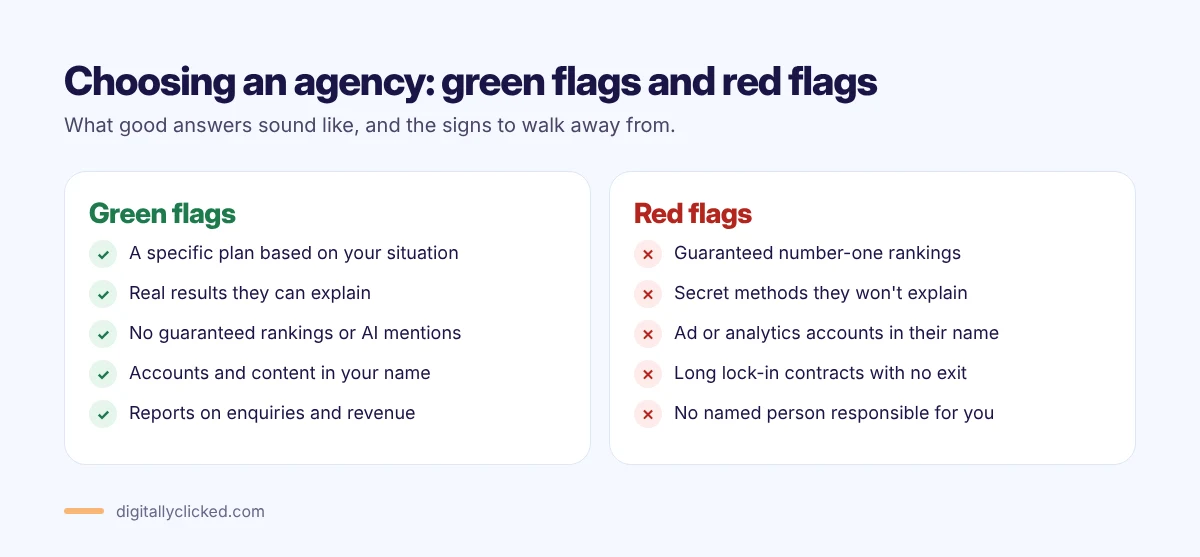
- Guaranteed number-one rankings or guaranteed AI mentions. Nobody controls Google or ChatGPT. A guarantee means either a trick or a promise they can’t keep.
- Secret methods they won’t explain. Good work can be explained in plain English.
- Ad or analytics accounts set up in their name. If you leave, you lose your data and history.
- Long lock-in contracts with no exit. A confident agency doesn’t need to trap you.
- Reports full of vanity numbers. Traffic that never turns into enquiries isn’t a result.
- No named person responsible for your account. You should know who to call.
Agency, freelancer or in-house?
Each option fits a different situation.
| Option | Best for | Watch out for |
|---|---|---|
| Freelancer | One specialist task, done well | Gaps when you need more than one skill |
| In-house hire | Daily focus on your business | One person rarely covers every skill |
| Agency | A team across SEO, AEO, websites, ads and content | Junior staff doing the work after a senior pitch |
| Agency plus in-house | Growing businesses with a marketer on staff | Unclear split of responsibilities |
Many growing businesses combine them: one in-house marketer who knows the business, working with a specialist agency for the skills they can’t hire.
How should you compare proposals?
Put the proposals side by side and score them on the same five points:
- Fit. Does the plan respond to your goal, or could it have been sent to anyone?
- Clarity. Could you explain the plan to a colleague after one read?
- Proof. Are the examples relevant to your size and market?
- Ownership and terms. Do you own everything, and can you leave fairly?
- Measurement. Is success defined in enquiries or revenue, with a date to review?
Price matters, but compare it last. A cheaper proposal that leaves out reporting or strategy often costs more over a year.
A worked example
This is an illustrative example, not a client result.
A family-run dental practice wants more new-patient enquiries. It talks to three agencies.
Agency A promises “page one in 30 days” and a 12-month contract. Agency B sends a 40-page deck of services but can’t say who would do the work. Agency C asks for the practice’s analytics first, notices most enquiries come from Google Maps, and proposes three months of local SEO and profile fixes, then a review based on new-patient enquiries.
Agency C isn’t the cheapest, but it’s the only one whose plan starts from the practice’s own data, names the person doing the work and defines success in enquiries. That’s the one to shortlist.
What should happen in the first 90 days?
A good agency usually spends the first month understanding your business and fixing what’s broken, the second building, and the third measuring and adjusting. By day 90 you should have a clear report that says what was done, what changed and what happens next, on one page if possible.
If you’d like to put these questions to us, book a free chat. If you want a quick read on how your business shows up today, start with a free AI check, or see all our services.
What should the contract cover?
Read the contract as carefully as the proposal. It should state, in plain words:
- The scope. What’s included each month, and what costs extra.
- The term and notice period. How long you’re committed, and how you leave.
- Ownership. That your website, content, ad accounts, analytics and data belong to you, during and after the contract.
- Reporting. How often you’ll get a report and what it will include.
- Who does the work. The named lead on your account, and what happens if they leave.
- Payment terms. When invoices are sent and what ad spend is billed separately.
If anything you were told on a call isn’t in writing, ask for it to be added before you sign.
How do you get the most from a new agency?
The first weeks set the tone. Give the agency access to your website, analytics and ad accounts as user accounts, not by sharing your own password. Share your best customers’ common questions, your price list or quoting rules, and any past marketing that worked or didn’t. Agree one main goal and a date to review it. Then hold a short, regular check-in, every week or two at first, so small questions don’t turn into big delays. Agencies do their best work when they understand your business as well as you do.
Key takeaways
Common questions
If you need one thing done brilliantly, a specialist. If your channels need to work together, a full-service team avoids gaps between suppliers.
Long enough for the work to show results, with a clear and fair exit. Be wary of very long lock-ins.
What was done, what changed, what it means for enquiries, and what happens next.
Not always, but very low prices often mean junior teams, shortcuts or templated work. Ask exactly what’s included.
Make sure every account, file and login is in your name first. Then ask the old agency for a handover of current work and history before the new one starts.