THE SHORT ANSWER
AEO, or answer engine optimization, is making your business easy for AI tools like ChatGPT, Gemini, Perplexity and Google’s AI answers to find, understand, trust and recommend. SEO helps you appear in a list of links. AEO helps you become the answer when someone asks an AI tool for a recommendation.
What does AEO mean, in plain English?
Imagine you ask a friend, “Where should I get my bike fixed?” Your friend doesn’t hand you a list of ten shops. They name one, and tell you why. AI tools now do the same thing for millions of people every day.
AEO is how you become the shop your friend names. You make sure AI tools know who you are, what you do and why people trust you, so that when someone asks, your name comes up.
How is AEO different from SEO?
They work together, but they aim at different moments.
| SEO | AEO | |
|---|---|---|
| Where it happens | Google and Bing results pages | ChatGPT, Gemini, Perplexity, Google AI Overviews and AI Mode |
| What the person sees | A list of links | One written answer |
| Your goal | Rank high enough to get the click | Be named, described accurately and recommended |
| What helps most | Relevant pages, technical health, links | Clear facts, consistent details, direct answers, trusted mentions |
| How you measure it | Rankings, clicks, enquiries | Mentions, accuracy, recommendations |
You’ll also hear GEO (generative engine optimization). It describes almost the same work. Our guide to AEO vs SEO vs GEO explains the differences.
Why does AEO matter now?
More people ask AI tools for recommendations instead of scrolling through search results. When an AI gives one answer instead of ten links, being that answer is worth far more than being link number seven.
There’s also a timing effect. AI tools learn from what’s published and repeated about a business. The businesses that are clear, consistent and well described today are building a lead that gets harder to catch every month.
How does AEO work?
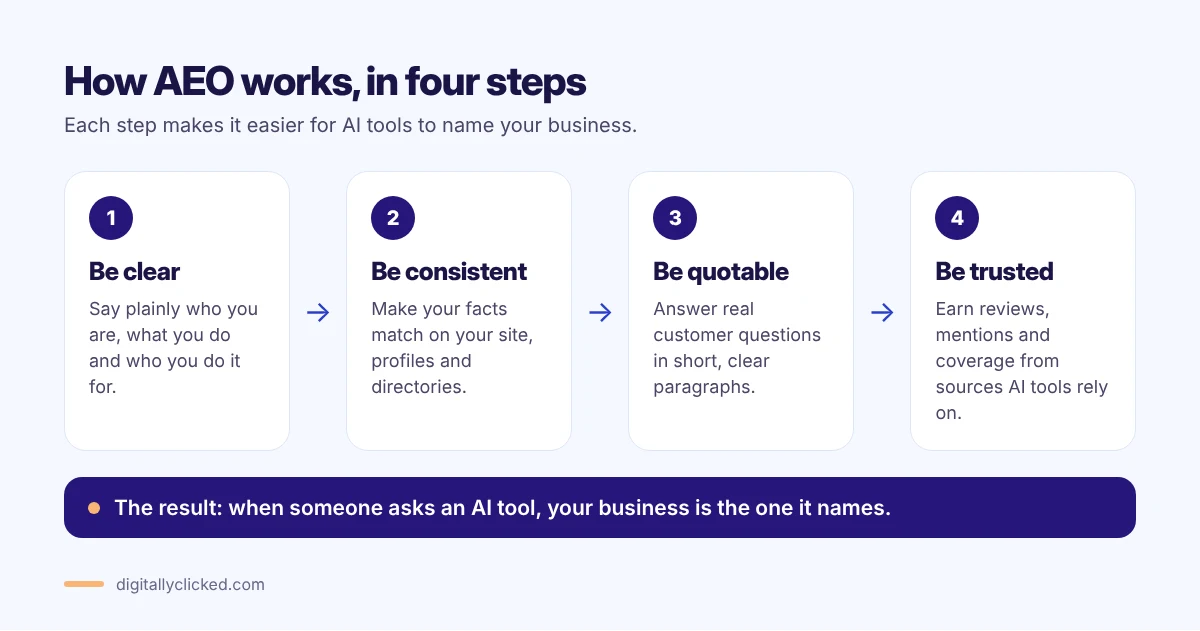
AEO comes down to four steps.
- Be clear. State plainly who you are, what you do and who you do it for, on your homepage and on each service page. Avoid slogans that don’t say what you sell.
- Be consistent. Make sure your facts match everywhere: your website, Google Business Profile, LinkedIn, directories and review sites. Conflicting details make AI tools less sure about you.
- Be quotable. Answer real customer questions directly, in short paragraphs that make sense on their own. AI tools often lift a passage that answers the question in its first sentence or two.
- Be trusted. Earn reviews, mentions and coverage from sources AI tools rely on, such as respected industry sites, local press and well-known directories.
Behind the scenes, technical basics matter too. AI crawlers need to be able to read your pages, structured data helps them understand what each page is about, and a facts page gives them one reliable source for your details.
Quick self-check: are you ready for AI answers?
Tick what’s true for your business today.
- Our website says clearly what we do and who for
- Our name, address and details match everywhere online
- We answer common customer questions on our site
- We have recent reviews on trusted sites
- Other sites have written about or linked to us
If you ticked fewer than three, AI tools may struggle to describe you accurately. That’s normal, and fixable.
A worked example
This is an illustrative example, not a client result.
A physiotherapy clinic asks ChatGPT, Gemini and Perplexity “Who’s the best sports physio in \[town\]?” Two tools name a competitor. One describes the clinic, but lists an old address and says it only treats back pain.
The clinic’s homepage leads with “Move better, live better” and never mentions sports injuries. Its old address is still on two directories. Its reviews are mostly on a site the AI tools don’t seem to cite.
The clinic rewrites its homepage and sports service page to say plainly what it treats and for whom, fixes the old address everywhere, adds answers to common sports-injury questions, and asks recent patients to leave reviews on its Google Business Profile. A few months later, it checks the same questions in each tool again to see what changed.
How do you measure AEO?
Start with a fixed list of the questions your buyers ask. Each month, ask them in the main AI tools and record three things: whether you’re named, whether the description is accurate, and which sources the tool cites. Over time, that shows whether your work is changing what AI tools say about you.
To see where you stand today, get a free AI check: we’ll show you what the main AI tools say about your business, in plain English. To see how we do this work for clients, read about our AEO services.
What are the common AEO mistakes?
- Clever slogans instead of plain descriptions. “Move better, live better” tells an AI tool nothing about what you sell. Say what you do in the first line.
- Outdated details on old profiles. An old address or phone number on a forgotten directory can be repeated in AI answers. Search for your business name and fix what you find.
- One page trying to cover everything. A single “Services” page that lists ten things gives AI tools little to quote. One clear page per main service works better.
- Waiting for perfect. Clear, consistent, accurate information published now is worth more than a polished plan published next year.
- Expecting guarantees. No one controls what AI tools say. Be wary of anyone who promises specific AI mentions.
What does an AEO project look like?
Most AEO work follows the same rhythm.
- Month 1: check and fix. Record what AI tools say about you today, fix inaccurate details across your profiles, and make sure AI crawlers can read your site.
- Months 2 to 3: clarify and answer. Rewrite key pages so they open with direct answers, add structured data and a facts page, and publish answers to the questions buyers ask most.
- Months 3 onward: build trust and measure. Earn reviews and mentions from credible sources, and re-check the same buyer questions every month to see what’s changed.
The early fixes often show results quickly. Trust builds more slowly, which is why it pays to start early.
Which AI tools should you check?
Check the tools your customers are most likely to use. For most businesses that means ChatGPT, Google’s AI features (AI Overviews and AI Mode), Gemini, Perplexity and Microsoft Copilot. Each one draws on sources in its own way, so a business can be named in one and missing in another.
Ask each tool the same questions, in the words a customer would use, and keep the list fixed so you can compare month to month. Note whether you’re named, whether the details are right, and which websites the tool cites. Those cited sources are often the best places to make sure your business is listed accurately.
Common questions
No. AI tools lean on the same signals search engines do. Good SEO is the foundation; AEO builds on it.
Quick fixes can show within weeks. Building real trust with AI tools usually takes a few months.
No one honestly can. We can make you far easier to find, understand and trust, and track the results.
It’s a small, low-cost step that some AI tools may use. It helps most when the rest of your site is already clear.
Start with our free AI check. We’ll show you exactly what the main AI tools say.