THE SHORT ANSWER
SEO gets your pages ranking in search results so people click through. AEO gets your business named as the answer by AI assistants like ChatGPT, Gemini, Perplexity and Google’s AI features. GEO is a newer name for much the same work. Most businesses need one joined-up plan: SEO foundations, with AEO built on top.
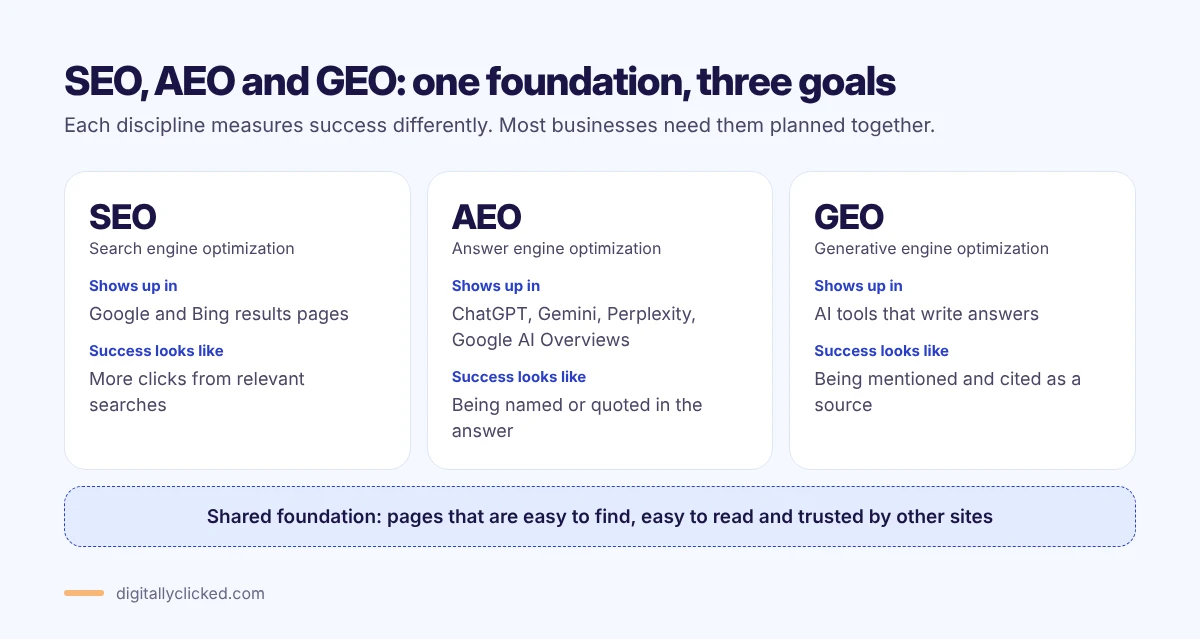
What do SEO, AEO and GEO actually mean?
All three are about being found. The difference is where you are found and what counts as success.
SEO (search engine optimization) helps your pages appear in Google and Bing results. A person types a search, sees a list of links and picks one. Success is a click from someone looking for what you sell.
AEO (answer engine optimization) helps your business become the answer when someone asks an AI tool a question. There is often no list to pick from. The AI writes a reply and names one or two businesses. Success is being named, described accurately and recommended.
GEO (generative engine optimization) is a term from researchers and some agencies for the same goal, framed around AI tools that generate written answers and cite sources. In practice, AEO and GEO describe almost the same work. We use AEO because it’s the plainer name.
| SEO | AEO | GEO | |
|---|---|---|---|
| Stands for | Search engine optimization | Answer engine optimization | Generative engine optimization |
| Where it shows up | Google and Bing results pages | ChatGPT, Gemini, Perplexity, Google AI Overviews and AI Mode | AI tools that write answers |
| What the person sees | A list of links | One written answer | One written answer with sources |
| Success looks like | More clicks from relevant searches | Being named or quoted in the answer | Being mentioned and cited as a source |
| How you measure it | Rankings, impressions, clicks, enquiries | Mentions, accuracy, recommendations | Citations and mentions |
Where do they overlap?
More than most people expect. Many AI tools search the web before they answer. They pull from pages that are easy to find, easy to read and trusted by other sites. That is exactly what good SEO builds.
So a page that ranks well and answers a question clearly already has a head start in AI answers. Think of SEO as the foundations of a house and AEO as the rooms people actually walk into. You can’t skip the foundations, but nobody visits a house for its foundations.
The shared groundwork includes:
- A site search engines and AI crawlers can read, with no important page blocked or hidden behind scripts.
- One clear page per service, each saying what you do, for whom and where.
- Fast pages that work well on a phone.
- Links and mentions from credible sites in your industry.
How is AEO different from SEO in practice?
AEO asks for a few things classic SEO often skips.
Who you are, not just which keywords you target. AI tools build an understanding of your business as an “entity”: a named thing with a type, a location, services and relationships. If your site, profiles and directory listings describe you differently, the AI has to guess, and it may guess wrong or leave you out.
Direct answers. AI tools quote short, self-contained passages. A page that answers the question in its first two sentences is easier to use than one that warms up for three paragraphs.
Consistent facts everywhere. Your name, address, services and prices (if you publish them) should match on your website, Google Business Profile, LinkedIn and directories.
Proof from other people. Reviews, mentions in articles and listings on respected sites tell AI tools that real people trust you.
Different measurement. SEO tracks rankings and clicks. AEO tracks whether you’re mentioned, whether the description is accurate, and which sources the AI cites when it talks about your market.
Which should you invest in first?
It depends on where you’re starting.
- If your site is slow, unclear or barely indexed, fix the SEO foundations first. AI tools struggle to recommend a business they can’t read.
- If you already rank reasonably well, add AEO now. You have the foundations; what’s missing is clarity, consistency and proof.
- If you’re launching something new, plan both together so every page works for search results and AI answers from day one.
Rule of thumb: SEO helps people find your pages. AEO helps AI tools find, trust and recommend your business.
A worked example
This is an illustrative example, not a client result.
A regional accounting firm ranks on page one of Google for “accountant for startups” in its city. When someone asks ChatGPT “Who’s a good accountant for a tech startup in \[city\]?”, the firm isn’t mentioned. Two competitors are.
A quick check shows why. The firm’s homepage says “Trusted advisors since 1998” but never says “startups”. Its Google Business Profile lists it as “Bookkeeping service”. Its partners’ LinkedIn pages describe different specialties. The competitors’ sites state plainly that they work with startups, answer common startup tax questions, and are listed in two local startup directories.
The fix is mostly AEO, not SEO: rewrite the service page to open with a direct answer about who the firm helps, align the profile category and LinkedIn descriptions, publish answers to five common startup questions, and get listed where the competitors are. The rankings the firm already has stay in place and keep working.
What does a joined-up plan look like?
- A technical health check so search engines and AI crawlers can read every important page.
- One clear page per service, each opening with a plain-English answer.
- A facts page and consistent business details across the web.
- Content built around the real questions your buyers ask.
- Reviews and mentions from credible sources in your industry.
- Monthly tracking of rankings, enquiries and what AI tools say about you.
If you want to see where you stand today, get a free AI check: we’ll show you what the main AI tools say about your business. To see how we approach this work, read about our AEO services and our SEO services.
What mistakes should you avoid?
- Treating AEO as a separate project. If your SEO and AEO work are planned by different people with different goals, you’ll publish pages that serve neither well. Plan them together.
- Chasing acronyms instead of buyers. Whether a supplier calls it AEO, GEO or AI SEO matters less than whether they can show what AI tools say about you today and how they’ll change it.
- Writing for machines. Pages stuffed with keywords or written to “trick” AI tools read badly to people, and people are still the ones who buy. Clear writing works for both.
- Ignoring your profiles. Many AI answers lean on directories, review sites and business profiles. A perfect website can’t make up for an outdated Google Business Profile.
- Measuring only rankings. Rankings tell you part of the story. Track enquiries, and check regularly whether AI tools name and describe you correctly.
How do you track all three together?
Keep one monthly report with three parts. For SEO: impressions, clicks and the searches that bring enquiries, from Google Search Console and your analytics. For AEO and GEO: a fixed list of 10 to 15 buyer questions, asked in ChatGPT, Gemini, Perplexity and Google AI Mode, noting whether you’re named, whether the description is accurate and which sources are cited. For the business: enquiries and where they came from. Seen side by side, the three tell you what’s working and where to focus next.
Key takeaways
Common questions
Mostly in name. GEO is often used for AI tools that write answers and cite sources; AEO covers the same work. What matters is the outcome: being found, understood and recommended.
No. Many AI tools rely on the same signals search engines use. Strong SEO is the foundation that AEO builds on.
Yes. Much of the early work is clarity and consistency: saying plainly what you do and making your details match everywhere. That costs time more than money.
Ask them the questions your customers ask, in more than one tool, and note who gets named. Or start with our free AI check.
Quick fixes like clearer service pages can show within weeks. Building enough trust for AI tools to recommend you consistently usually takes a few months.